
If your organization runs Infor M3, the operational data you need is already being captured across every site, entity and currency. Turning it into a number that finance and operations both trust is the part that takes work.
Cipher is an enterprise performance management and analytics firm. We work with organizations already running M3 to build the reporting, dashboards and planning that sit on top of it, so leadership gets answers from the system instead of from a spreadsheet someone rebuilt last night.
What is Infor M3?
Infor M3 is Infor's cloud ERP for global manufacturers, distributors and service organizations. It covers order management, production, inventory, supply chain and financials, and it is built for companies operating across multiple sites, legal entities, currencies and languages. It runs as a cloud service and in older on-premise installations.
Its strength is depth in complex, multi-country operations. Its practical limitation, and the reason most teams eventually come looking, is that an ERP is built to run transactions rather than to explain them. Standard reports tell you what happened inside a module at one site. They rarely answer a question that crosses sites, entities or currencies.
Is Infor M3 the same as Movex?
Yes. M3 is the current name for the ERP originally sold as Movex, built by the Swedish software company Intentia. Intentia merged with Lawson Software, and Infor acquired Lawson in 2011. Long-standing customers and job listings still use the Movex name, so both refer to the same product line.
This matters more than a naming footnote when you are matching documentation to your environment. Older material, internal runbooks and experienced staff may all use the earlier name, while current Infor documentation does not. The version and deployment model are more reliable identifiers than the product name.
Are Infor and M3 the same?
No. Infor is the software vendor. M3 is one of several ERP products Infor sells, alongside SyteLine (CloudSuite Industrial), LN, XA and others. "Infor" names the company, "M3" names the system. In everyday use people say "Infor M3" to mean the ERP itself, which is where the confusion starts.
The distinction matters when a group runs more than one Infor ERP, which is common after an acquisition. Two Infor systems are still two different data models, and consolidating across them is its own piece of work.
Is Infor M3 a CRM?
No. Infor M3 is an ERP. It manages orders, customers, production, inventory, supply chain and financials, so it holds customer and order data, but customer relationship management is a separate product line that Infor sells alongside it. Pipeline, campaign and service management sit next to M3 rather than inside it.
This matters for reporting more than it looks. When commercial data lives in a CRM and delivery data lives in M3, questions like cost to serve or margin by customer cross both systems, and neither one can answer alone.
Who runs Infor M3?
M3 concentrates in industries where the product itself is complex to plan and track: food and beverage, fashion and apparel, chemicals, distribution, and equipment manufacturers with a service and rental business attached. What those have in common is short shelf life, seasonal cycles, deep product variation, or an installed base that has to be serviced long after the sale.
They also tend to be genuinely international. That is why the reporting problem on M3 looks different from the one on a single-site ERP: the difficulty is rarely one number, it is the same number meaning different things in six places.
Is Infor M3 a good ERP system?
For the profile it targets, yes. M3 is strong in multi-site, multi-currency manufacturing and distribution, and it holds up in industries with complex products and long service lives. It suits smaller single-site operations less well, where its breadth becomes overhead. The most common complaint is not capability, it is getting answers back out.
That is worth being direct about, because it is the reason most teams start looking for help. The transactions are recorded correctly. What is missing is a layer that turns them into a consolidated, trusted number without a week of manual work. That is a different problem from the ERP being wrong, and it has a different solution.
Where Infor M3 reporting gets difficult
The pattern is consistent across the organizations we talk to:
- Multi-entity and multi-currency consolidation is manual. Every additional legal entity multiplies the reconciliation work rather than adding to it, and currency translation is rebuilt by hand each cycle.
- Operational truth and financial truth drift apart. Production, inventory and orders live in M3. The budget, the forecast and the board pack live in spreadsheets.
- Cross-site questions have no home. Margin by product line across plants, or cost-to-serve by customer across regions, requires joining data no single standard report covers.
- Definitions vary by site. When each location has interpreted a field its own way, a consolidated report is arithmetic on top of inconsistent inputs.
- Planning is disconnected from actuals. Budgets get built on last quarter's export, so the plan is stale before the cycle closes.
None of this means the ERP was implemented badly. It means the reporting and planning layer was never built.
What Cipher does with Infor M3 data
We are not the M3 ERP implementer, and we work alongside whoever is. We do not sell or resell M3 licenses. What we build is the layer above it:
- Reporting and dashboards leadership actually uses. We build on Infor BI and Infor Birst, so M3 data reaches decision-makers in a form they can act on rather than a report they have to interpret.
- Budgeting, forecasting and consolidation. With Infor EPM (d/EPM), we connect planning and forecasting directly to M3 actuals, so the plan updates as the business moves.
- Group consolidation across entities. Multi-entity, multi-currency groups get a repeatable financial consolidation instead of a monthly reconciliation exercise.
- Integration with the rest of the estate. M3 rarely stands alone. We connect it to the adjacent systems that also hold pieces of the answer, including Infor SyteLine and Infor CloudSuite Business environments in groups that run more than one Infor ERP.
- Ongoing support. Reporting decays as the business changes. We keep models and dashboards current, so they stay trusted.
How M3 data reaches Infor EPM
The hard part is rarely the reporting logic. It is the connection between the ERP and the performance management layer, which has to be built against how your M3 environment is actually configured, then re-pointed whenever either system moves. The two seldom move together.
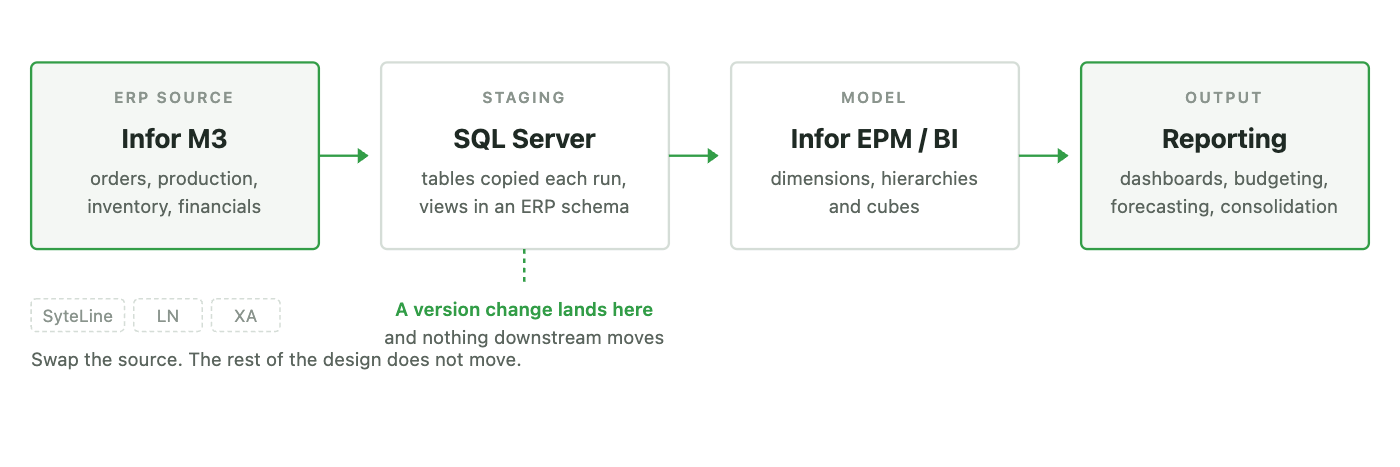
That connection is the work we do. Our Infor EPM practice spans Infor EPM 11 and 12, on-premise and cloud, and our hands-on ERP integration experience to date is on the SyteLine line, across versions 9 and 10 in both deployment models.
We have written one of those builds up in full: loading SyteLine data into Infor d/EPM 11, covering the source tables it draws from, the dimension model built over them, and a complete cube rebuild in under 90 seconds. The approach on M3 is the same. What changes is the source. Different tables, different keys, and a multi-entity structure that makes the mapping larger rather than different. If you want to see how we work before talking to us, that article is the clearest picture of it.
If you are moving M3 to the cloud, or upgrading, the reporting question is worth answering before the migration rather than after. Building a clear picture of what the business actually measures gives you a baseline to validate the new environment against. Without it, you are comparing a new system to a memory of the old one.
Talk to a consultant about your Infor M3 data
Book a free 30-minute consultation. One of our consultants will look at how you report from M3 today and map out what a reporting and planning layer would involve for your environment. No obligation, and no license sales: we sell services.