
The difference in OKR vs KPI is purpose, not a choice of method. A KPI measures whether the business is healthy. An OKR names a change you are trying to make this cycle, and how you will know you made it. If you also need the difference between KPIs and metrics, that lives on its own page.
What is the difference between an OKR and a KPI?
A KPI is a standing measure of health, such as days to close or forecast accuracy. An OKR is a time-bound objective plus a few key results that describe a change you are trying to make this cycle. KPIs keep running after the quarter ends. OKRs expire, get scored, and are rewritten. Most enterprises need both.
- KPI: a standing health measure with an owner, a target, and a known data source. It does not expire with the quarter.
- OKR: a qualitative objective plus three to five measurable key results, scored at the end of a cycle, then rewritten.
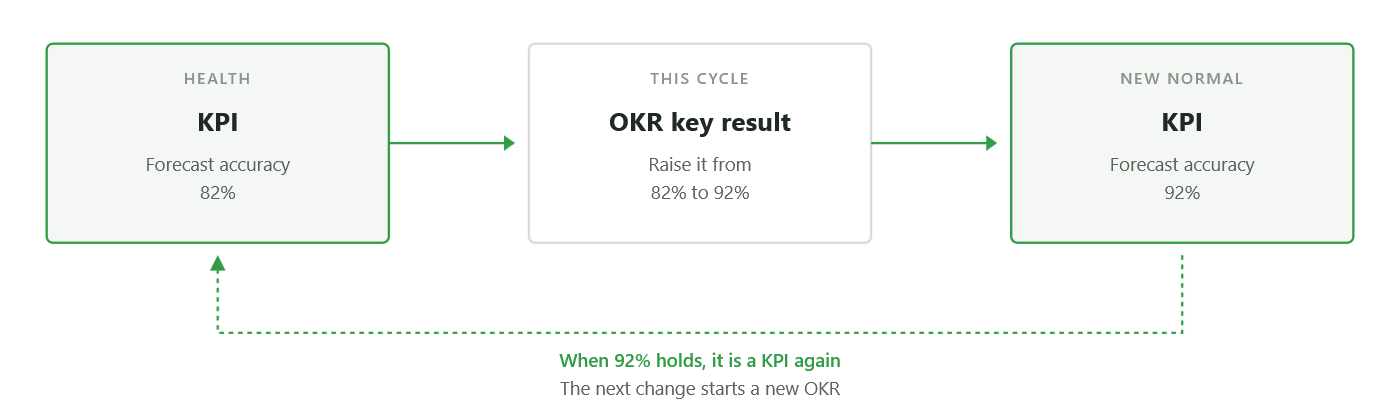
- Together: a key result can be a KPI you have decided to move this cycle, for example forecast accuracy from 82% to 92%. Once 92% holds, that number goes back to being a KPI.
They are not competing methods. Treating them as a choice is how organizations either stop measuring day-to-day health, or never set a goal that would actually move a number.
What is a KPI?
A KPI, a key performance indicator, is a standing measure of whether a process or the business is healthy. On-time delivery, days to close, forecast accuracy, inventory turns, and customer retention are KPIs when a named owner watches them on a fixed cadence, against a target, with a known data source.
A KPI does not expire when the quarter ends. The target can move, the owner can change, and the definition can be tightened, but the measure itself is part of how the organization runs. That is why a good KPI set is small. If everything is a KPI, nothing is. There is no universal "top three KPIs." The right set is the handful of numbers that would change a decision if they moved.
What is an OKR?
An OKR, an objective and key results, is a time-bound goal-setting structure. The objective is a qualitative statement of what you want to achieve in a cycle, usually a quarter or a year. The key results are three to five measurable outcomes that tell you whether that objective happened. More than five and the objective has no focus.
The acronym has two parts, not five: the objective and the key results. Teams then add a cycle, an owner, and a score so the OKR can be run. Those last three are operating habits, not extra letters in the name.
OKRs are designed to be ambitious. A cycle that scores a comfortable 100% on every key result usually means the objective was a KPI in disguise: a health measure, not a change. When the cycle ends, the OKR is scored and rewritten. It does not sit on the dashboard forever.
Can you use OKRs and KPIs together?
Yes. Use KPIs for the health of processes that already exist, and OKRs for the few changes you are trying to make this cycle. A key result can be built on a KPI. "Raise forecast accuracy from 82% to 92%" is an OKR key result. After 92% becomes the new normal, forecast accuracy goes back to being a KPI.
The failure is not using both. The failure is running them in separate tools so the ambition never meets the actuals.
What is an example of an OKR vs a KPI?
Here is the same business goal expressed both ways, for a group finance team in a multi-entity manufacturer. Leadership wants a monthly number operations will actually run on, instead of a pack that arrives late and gets rebuilt in spreadsheets.
| As KPIs (health) | As an OKR (ambition) | |
|---|---|---|
| Frame | Standing measures, owned, reported every cycle | Objective: make the monthly group forecast the number operations actually uses |
| Measure 1 | Forecast accuracy is 82% | Raise forecast accuracy from 82% to 92% at SKU level |
| Measure 2 | Days to close is 8 | Cut days to close from 8 to 2 |
| Measure 3 | 47 manual consolidation adjustments per cycle | Reduce manual adjustments from 47 to under 10 |
| When it ends | It does not. These stay on the scorecard | The cycle is scored. If 92% holds, accuracy becomes a KPI again |
The left column is how you know the process is under control. The right column is a quarter of focused work that would change those numbers. Most teams only write the left column, then wonder why the numbers never move. Others only write the right column, then lose the health measures the moment the OKR cycle turns over.
When should you use an OKR instead of a KPI?
Use a KPI when the process exists and you need a trusted reading of it. Close, delivery, quality, cash, and pipeline need a number that does not get reinvented every January. Use an OKR when you need a change, not a reading: a new consolidation path, a forecast operations will consume, a service level you have never hit.
Use both when the organization is large enough that strategy and operations can drift. That is most enterprises. The KPI set is the heartbeat. The OKR set is this quarter's attempt to improve a few of those beats, without pretending the rest of the business can go unmeasured while you do it.
Are OKRs still relevant?
Yes. OKRs remain the structure for time-bound, ambitious change. They did not replace KPIs, and they did not go stale as a method. Organizations that dropped their KPI set after adopting OKRs lost the health measures the business still needs. Organizations that only keep KPIs rarely make a deliberate change to those numbers.
Why enterprises need both, and what breaks when they live in separate tools
The failure mode is architectural, not conceptual. Strategy writes OKRs in a slide or in a dedicated OKR product. Finance keeps KPIs in the EPM layer, fed from SAP or Infor. Operations keeps another set in a plant dashboard. On paper everyone agrees they should connect. In the monthly review they do not, because there is no single place where the objective, the KPI, and the actual sit together.
Three things then happen, and they happen quietly:
- The target in the OKR is not the target on the KPI. Strategy typed 92%. The scorecard still shows 85% as the goal because nobody updated the measure definition.
- The actuals feeding the OKR are a different extract from the actuals feeding the board pack. Both numbers are "from the ERP." They still do not match.
- When the OKR cycle ends, the KPI is forgotten or the OKR is left to rot on a dashboard as a fake health measure. Either way the organization loses the distinction this article is about.
That is not an argument against OKR software, and it is not an argument against EPM. It is an argument against running ambition and health as two disconnected systems and hoping a monthly meeting will reconcile them.
How a single platform holds objectives, KPIs and targets together
This is the job of a strategy execution layer. Cipher SPEAR is Cipher's strategy execution platform: objectives, KPIs, targets, initiatives and scorecards in one model, so the OKR and the KPI are not two exports that have to be lined up by hand.
SPEAR does not replace the ERP or the planning system. It sits on top of them, the same way Cipher's organizational strategy and performance work has always sat on top of SAP and Infor estates. The measure definition is written once. The actuals come from the systems that already hold them. Leadership sees the objective, the KPI, and the initiative in the same scorecard instead of in three files.
See OKRs and KPIs on the same scorecard
A short demo is enough to see whether this split is a wording problem or a systems problem in your environment. We will look at how you set objectives today, where the KPIs actually live, and what a single scorecard would change.