
What Is IBM Cognos TM1?
IBM Cognos TM1 is an in-memory planning and budgeting engine that lets finance teams build multidimensional models and calculate results instantly, instead of waiting on an overnight batch job. IBM now sells it commercially as IBM Planning Analytics, with TM1 as the underlying engine that does the actual modeling and calculation work. In practice, "TM1" and "Planning Analytics" refer to the same technology at different layers, and most existing installations still run and are administered as TM1.
With its in-memory modeling technology, TM1 lets you build multidimensional cubes with multiple hierarchies for products, customers, cost centers, and more, then plan at any level of detail across them. Real-time calculation means users can run what-if scenarios and perform top-down or bottom-up planning on the fly, adapting the same model to different situations across the organization instead of maintaining separate spreadsheets for each one.
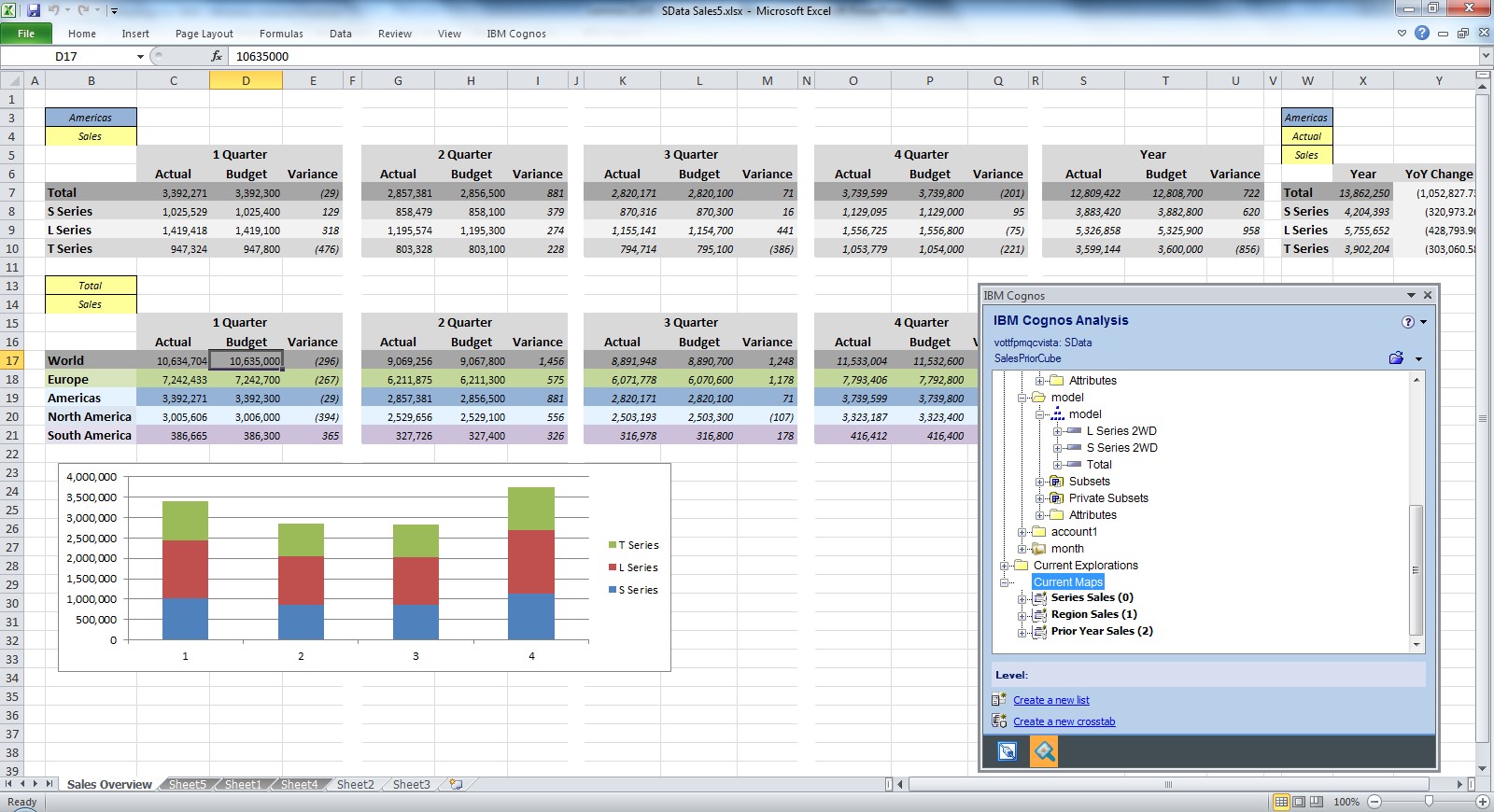
Actuals can be pulled in from practically any source to support analysis, reporting, and distribution. Users interact with the model in more than one way, including a web interface and, for power users, Planning Analytics for Microsoft Excel (PAx), which lets finance explore data, build reports quickly, and create forms and visualizations without needing a developer for every change.
A Short History: How TM1 Became an IBM Product
TM1 (the name stands for Table Manager 1) was created in 1983 by Sinper Corporation as one of the earliest in-memory OLAP engines built for financial planning. Applix acquired Sinper in 1996 and spent the next decade turning TM1 into a purpose-built planning and budgeting platform. Cognos acquired Applix in 2007, and IBM acquired Cognos shortly after, bringing TM1 into the IBM portfolio as IBM Cognos TM1. In 2016, IBM rebranded and expanded the product as IBM Planning Analytics, with TM1 continuing on as the underlying data engine and version numbering.
TM1 vs. Planning Analytics: What's the Difference?
There isn't a hard line between the two. TM1 refers to the in-memory calculation engine itself, the multidimensional cubes, rules, and real-time processing underneath everything. Planning Analytics is IBM's current commercial name for the full product, including the web interface, Planning Analytics for Microsoft Excel (PAx), and the newer administration tooling built on top of that engine. If your team still calls it "TM1" day to day, that's normal. Most installations, including older ones, are still TM1 under the hood even when the license and product name say Planning Analytics.
Is TM1 Still Actively Developed?
Yes. IBM continues to release updates to Planning Analytics and the underlying TM1 engine, so it isn't a legacy product IBM has stopped investing in. That said, "still supported" and "the right fit for where your organization is headed" are two different questions, which is exactly why the modernization section below exists as a separate, honest conversation rather than an assumption baked into the rest of this page.
What Cipher Does with TM1
- Implementation, including cube and dimension model design: structuring the model around how your organization actually plans, not a generic template
- Planning Analytics for Microsoft Excel (PAx) rollout and report building: getting finance working in a familiar Excel front end instead of a separate tool they have to be re-trained on
- Model performance tuning and rule optimization: tracking down the slow rules and oversized cubes that make a once-fast model feel sluggish years later
- Upgrades from older TM1 versions onto Planning Analytics: moving forward without a full rebuild, where that's feasible
- Ongoing support and admin coverage for existing TM1 estates: for teams that inherited a model with no documentation and need a partner who can actually read the rules
- Training so finance owns the model instead of depending on a developer: the goal is a self-sufficient team, not a support ticket every time a dimension needs to change
Moving Off TM1, or Consolidating Onto One Platform
A lot of TM1 searches come from administrators of aging estates: models built years ago, now running with limited documentation and whoever happens to still know the rules. If that describes your environment, it's worth asking the question honestly before deciding either way. A few signs point toward optimizing what you already have:
- The model still runs fast and the rules are documented well enough that more than one person understands them
- TM1 is the only planning tool in the organization, so there's no consolidation benefit to chase
- The team using it is comfortable in it and productive
And a few signs point the other way, toward consolidating onto a platform the rest of finance already runs:
- TM1 is the last standalone planning tool while the rest of the organization has moved onto SAP or Infor
- The person who built the model has left, and nobody left on staff can safely change a rule
- Reporting increasingly has to be reconciled by hand between TM1 and whatever system holds the actuals
Cipher helps organizations work through that decision either way. Where consolidation makes sense, Cipher also helps move TM1 budgeting and planning onto Infor EPM consulting or SAP instead, and the same team that supports TM1 runs those migrations, so the choice comes down to what fits your environment, not which vendor you happen to talk to first. This isn't a claim about IBM's product direction, it's an observation that many TM1 shops are asking the consolidation question anyway, and it's better to answer it deliberately than by default when a key person leaves.
If your TM1 model already covers budgeting and forecasting, see how we approach budgeting and forecasting software more broadly, or if it feeds into a close and consolidation process, see our approach to financial consolidation software. For organizations weighing a move onto SAP's stack specifically, see SAP Analytics Cloud.
Natura TM1 Case Study
Cipher implemented TM1 for Natura, revitalizing the cosmetics company's budgeting and planning process with greater agility and stronger insight into performance. Moving planning onto an in-memory model gave the finance team a faster, more flexible way to work with the numbers than the process it replaced, without the wait typical of batch-driven planning tools. The result is a planning process that keeps pace with a fast-moving consumer business instead of holding it back.
Running TM1 and unsure whether to optimize it or move it? In a free 30-minute review, Cipher's consultants look at your model, your reporting load, and your options.