
If your organization runs Infor LN, the operational data you need is already being captured across every site, project and currency. Turning it into a number that finance and operations both trust is the part that takes work.
Cipher is an enterprise performance management and analytics firm. We work with organizations already running LN to build the reporting, dashboards and planning that sit on top of it, so leadership gets answers from the system instead of from a spreadsheet someone rebuilt last night.
What is Infor LN?
Infor LN is Infor's ERP for complex, project-driven and multi-site manufacturers. It covers order management, production, projects, supply chain, service and financials, and it runs both on-premise in the Infor LN 10.x line and in the cloud as part of Infor CloudSuite. It was originally sold as Baan.
Its strength is depth in operations where a single order behaves like a project and stays in service for years. Its practical limitation, and the reason most teams eventually come looking, is that an ERP is built to run transactions rather than to explain them. Standard reports tell you what happened inside a module at one company code. They rarely answer a question that crosses companies, projects or currencies.
Is Infor LN the same as Baan?
Yes. Infor LN is the current name for the ERP originally built and sold as Baan. The Dutch company Baan was founded in 1978 by Jan Baan, sold to Invensys in June 2000, sold on to SSA Global Technologies in June 2003, and acquired by Infor in May 2006. SSA renamed the product ERP LN, and Infor kept the LN name.
This matters more than a naming footnote when you are matching documentation to your environment. Long-tenured sites, internal runbooks and experienced staff often still say Baan, while current Infor documentation does not. If you are searching for help, it is worth searching both names. The version and the deployment model are more reliable identifiers than the product name.
Which Baan versions became Infor LN?
Baan IV and Baan V are the releases long-tenured sites still run or still name. The line was renamed ERP LN under SSA Global and shipped as SSA ERP LN 6.1 in August 2005, then became Infor ERP LN and finally Infor LN after the 2006 acquisition. On-premise sites today are generally somewhere in the Infor LN 10.x line.
For reporting, that lineage is not history. A Baan IV site and an LN 10.x site are different data models, and a reporting layer has to be built against the release you actually run rather than the product name on the contract. It is the single most common reason a generic Infor reporting template does not fit.
Are Infor and LN the same?
No. Infor is the software vendor. LN is one of several ERP products Infor sells, alongside SyteLine (CloudSuite Industrial), M3, XA and others. "Infor" names the company, "LN" names the system. In everyday use people say "Infor LN" to mean the ERP itself, which is where the confusion starts.
The distinction matters when a group runs more than one Infor ERP, which is common after an acquisition. Two Infor systems are still two different data models, and consolidating across them is its own piece of work.
Is Infor LN cloud or on-premise?
Both. Infor LN runs on-premise in the 10.x line, and in Infor's cloud as part of the CloudSuite range, where the multi-tenant edition is updated continuously rather than on numbered releases. A large share of long-standing Baan and LN sites are still on-premise, which is why hybrid estates are so common in this install base.
That split is where reporting usually breaks. The ERP and the performance management layer rarely move to the cloud at the same time, so for a period the two sit in different places with different refresh windows, and whatever connects them has to be built to survive one of them moving without the other.
Who runs Infor LN?
LN concentrates in industries where the product is complex to build and long-lived: industrial and equipment manufacturing, aerospace and defence, automotive, and engineer-to-order operations where a single order is effectively a project. Infor's first industry CloudSuite, CloudSuite Automotive, was built on LN in 2014. The install base also skews European, a legacy of Baan's Dutch origins.
That profile shapes the reporting problem. When an order runs for eighteen months across several companies and currencies, the difficult question is not what happened last month. It is whether this project is still going to land where it was planned to, and that answer lives in several places at once.
Where Infor LN reporting gets difficult
The pattern is consistent across the organizations we talk to:
- Multi-company and multi-currency consolidation is manual. Every additional legal entity multiplies the reconciliation work rather than adding to it, and currency translation gets rebuilt by hand each cycle.
- Project and order-level margin has no home. Cost, revenue and hours against a long-running order sit across modules, and no single standard report joins them over the life of the project.
- Operational truth and financial truth drift apart. Production, inventory and orders live in LN. The budget, the forecast and the board pack live in spreadsheets.
- Definitions vary by company code. When each site has interpreted a field its own way, a consolidated report is arithmetic on top of inconsistent inputs.
- The reporting tools that came with older releases answer an older kind of question. They were designed around module-level operational output, not around a cross-entity view that finance can sign off on.
- Planning is disconnected from actuals. Budgets get built on last quarter's export, so the plan is stale before the cycle closes.
None of this means the ERP was implemented badly. It means the reporting and planning layer was never built.
What Cipher does with Infor LN data
We are not the LN ERP implementer, and we work alongside whoever is. We do not sell or resell LN licenses. What we build is the layer above it:
- Reporting and dashboards leadership actually uses. We build on Infor BI and Infor Birst, so LN data reaches decision-makers in a form they can act on rather than a report they have to interpret.
- Budgeting, forecasting and consolidation. With Infor EPM (d/EPM), we connect planning and forecasting directly to LN actuals, so the plan updates as the business moves. If you are still working out what d/EPM covers, we have written a complete guide to Infor EPM.
- Group consolidation across companies. Multi-entity, multi-currency groups get a repeatable financial consolidation instead of a monthly reconciliation exercise.
- Integration with the rest of the estate. LN rarely stands alone. We connect it to the adjacent systems that also hold pieces of the answer, including Infor M3, Infor SyteLine and Infor CloudSuite Business environments in groups that run more than one Infor ERP.
- Ongoing support. Reporting decays as the business changes. We keep models and dashboards current, so they stay trusted.
Talk to a consultant about your Infor LN data
Book a free 30-minute consultation. One of our consultants will look at how you report from LN today and map out what a reporting and planning layer would involve for your environment. No obligation, and no license sales: we sell services.
Book a Free Infor EPM Reporting Review
How Infor LN data reaches Infor EPM
The hard part is rarely the reporting logic. It is the connection between the ERP and the performance management layer, which has to be built against how your LN environment is actually configured, then re-pointed whenever either system moves. The two seldom move together.
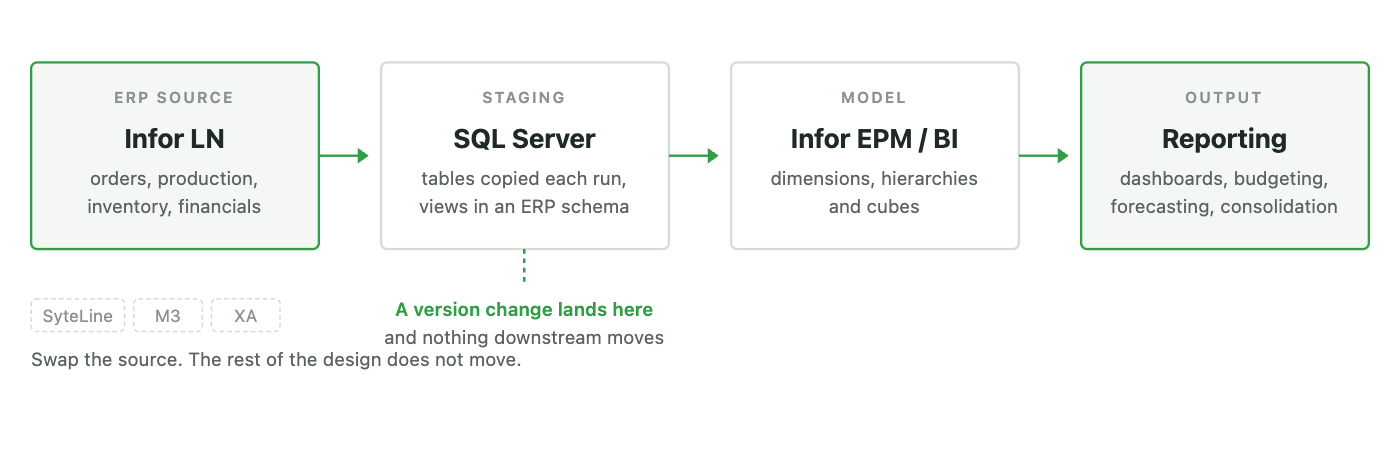
That connection is the work we do. Our Infor EPM practice spans Infor EPM 11 and 12, on-premise and cloud, and our hands-on ERP integration experience to date is on the SyteLine line, across versions 9 and 10 in both deployment models.
We have written one of those builds up in full: loading SyteLine data into Infor d/EPM 11, covering the source tables it draws from, the dimension model built over them, and a complete cube rebuild in under 90 seconds. The approach on LN is the same. What changes is the source. Different tables, different keys, and a multi-company structure that makes the mapping larger rather than different. If you want to see how we work before talking to us, that article is the clearest picture of it.
Upgrading Baan or LN? Plan the reporting alongside it
This is the most common reason organizations come to us about an ERP move. A version change or a cloud migration changes where and how the data sits, and the extracts that feed budgeting, forecasting and management reporting do not carry across untouched. If the EPM side is not adjusted in step, reporting breaks at cutover. The worse outcome is that it keeps running against stale structures and returns numbers nobody realizes are wrong.
Teams planning a move off Baan IV or Baan V, or from on-premise LN to CloudSuite, often assume reporting should wait until after. In our experience the opposite is more useful. Building a clear picture of what the business actually measures, before the migration, gives you a baseline to validate the new environment against. Without it, you are comparing a new system to a memory of the old one.