
If your organization has been running Infor CPM (PM10) for financial consolidation, budgeting, or forecasting, you've probably heard the same question from your Infor rep, your consultants, or your own finance team: should we move to Infor d/EPM? It's a fair question, and the answer depends on what CPM and d/EPM actually do differently, not just which one is newer.
Here's a plain-English comparison to help you decide.
What Is Infor CPM?
Infor CPM (Corporate Performance Management), also known by its earlier name PM10, is Infor's older Financial Performance Management platform. It handles consolidation, budgeting, and forecasting for finance teams, built on an OLAP engine that pre-processes calculations before reports can be produced.
What Is Infor EPM?
Infor d/EPM (Dynamic Enterprise Performance Management), often just called Infor EPM, is Infor's current platform for the same core use cases (consolidation, budgeting, forecasting) plus a broader set of business intelligence and analytics capabilities. It's built on a different, in-memory OLAP engine that calculates on the fly rather than through a pre-processing step.
Key Differences
On-the-Fly vs. Pre-Processed Calculations
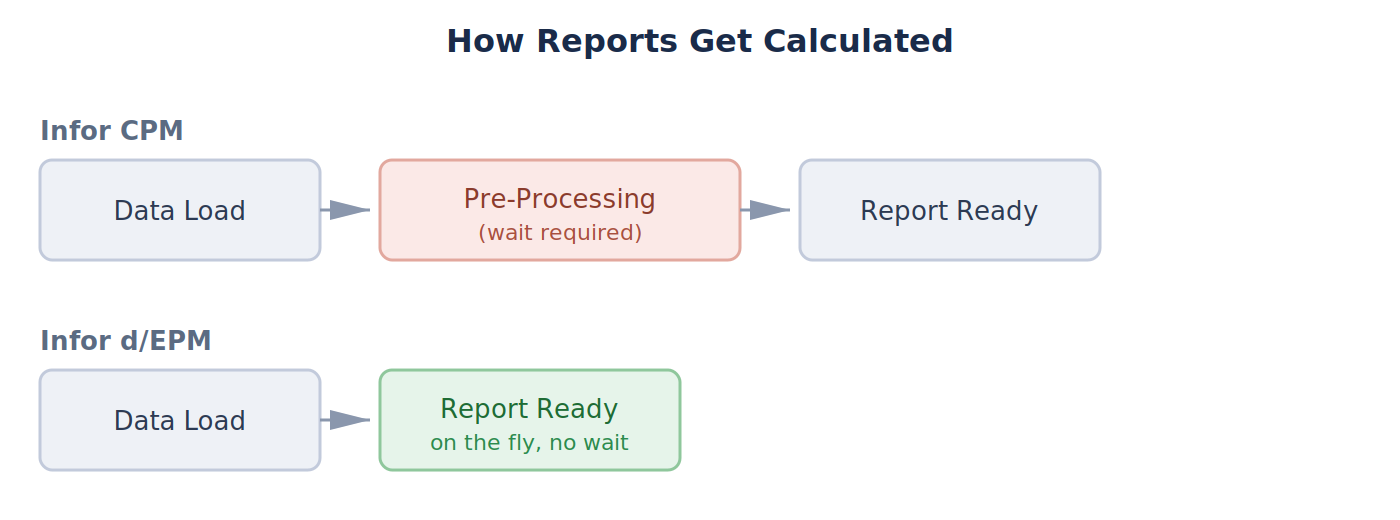
This is the biggest technical difference between the two platforms. In CPM, data has to be pre-processed before reports reflect it, and depending on the size of the model, that processing step can take real time, which delays reporting and slows down close cycles. In d/EPM, calculations happen on the fly, so there's practically no wait between loading or entering data and seeing it reflected in a report.
Versatility
CPM's engine is purpose-built for financial reporting. d/EPM's engine is generic, which means the same platform can support cubes and dimensions for logistics, production, sales, and other operational areas, not just finance. If your organization wants one performance management platform across multiple departments, d/EPM is the more versatile choice.
Infor CPM End of Life
This isn't a future concern. It's already happened. Vendor support for Infor PM10 (CPM) sunset by the end of 2021, which means organizations still running it are operating on unsupported technology. That carries real risk: no more security patches, no more fixes for emerging issues, and growing incompatibility with modern infrastructure over time. For CPM customers, the practical question isn't "if" to move to d/EPM. It's "when."
When Converting Is Worth It
Not every CPM installation needs to convert today. Converting tends to make the most sense when one or more of the following is true:
- Your close or reporting cycle is slowed down by CPM's pre-processing step
- You want to extend performance management beyond finance into operations, sales, or logistics
- You're concerned about long-term support and patching for CPM
- You want access to Infor Office Plus or other tools only available on d/EPM
What Conversion Involves
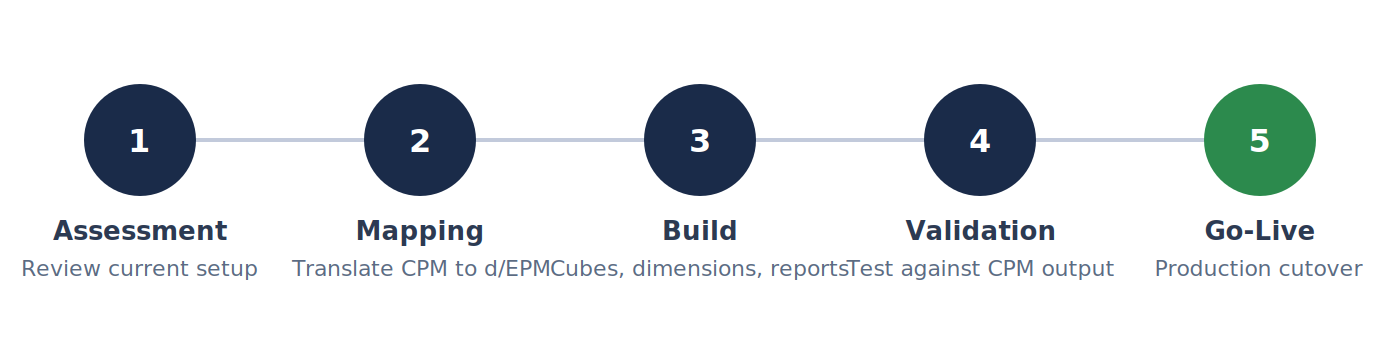
A CPM to d/EPM conversion typically follows five stages: assessment of your current CPM setup, mapping the CPM design onto the d/EPM structure, building the new cubes and dimensions (including converting existing reports), validating the converted environment against your original CPM output, and go-live.
The biggest practical obstacle is usually the existing report library. CPM and d/EPM share the same reporting tool, Infor Application Studio, but the way each platform references dimensions internally is different, so reports don't carry over automatically. Without a conversion tool, every report has to be adjusted by hand.
Cipher's Report Conversion Tool
This is the problem Cipher built a tool specifically to solve. Our CPM to d/EPM Report Conversion Tool automatically converts 80–100% of each Application Studio report definition, handling the repetitive, error-prone work of remapping dimension codes, lists, hyperblocks, and formulas. Some reports still need manual touch-ups afterward, but the bulk of the rework is done for you, which is a large part of why converting Infor CPM to Infor EPM with Cipher tends to move faster than teams expect.
Proven in Production
Cipher has implemented d/EPM for organizations across manufacturing, distribution, and services. T. Hasegawa USA, part of one of the world's top flavor and fragrance companies, is one example. Cipher's team deployed d/EPM across their sales, finance, and production departments, delivering the project on time and within budget. You can read the full T. Hasegawa Infor EPM case study for the details.
Is It Time to Convert?
If CPM is still meeting your needs today, there's no urgency to rip it out. But if you're feeling the pre-processing lag, want to extend performance management beyond finance, or are thinking about Infor's long-term direction, it's worth a real assessment rather than a guess. Our Infor EPM consulting team can tell you specifically what a conversion would look like for your environment.
Not sure if it's time to convert?
Book a free Infor EPM migration assessment and we'll tell you exactly what a CPM to d/EPM conversion would involve for your organization: timeline, scope, and what carries over automatically.