
If you're still running SAP Strategy Management (SSM) and searching for what happens next, you've probably already sensed the answer: SSM isn't getting new investment. Here's what that actually means, what you lose by staying, and what your real options are.
Is SSM Really End of Life?
There's an important distinction worth making here. SAP hasn't published a formal end-of-life date for SSM the way it has for other products like BusinessObjects BI. What has happened is quieter and, in some ways, more telling: SSM has seen no meaningful new development, no new feature investment, and it's no longer being actively sold or positioned as part of SAP's forward strategy. For practical purposes, that's the same outcome as end of life — the product isn't going anywhere new, and organizations still on it are managing a fixed asset, not a growing platform.
What You Lose If You Stay
Staying on SSM doesn't mean the software stops working tomorrow. It means a few things start compounding:
- No new functionality to match how your organization's reporting and planning needs evolve
- A shrinking pool of consultants and internal staff who still know the platform well
- Growing friction integrating with the rest of your SAP or BI stack, which keeps moving forward without SSM
- No roadmap to point to when leadership asks "what's next" for strategy reporting
Your Options
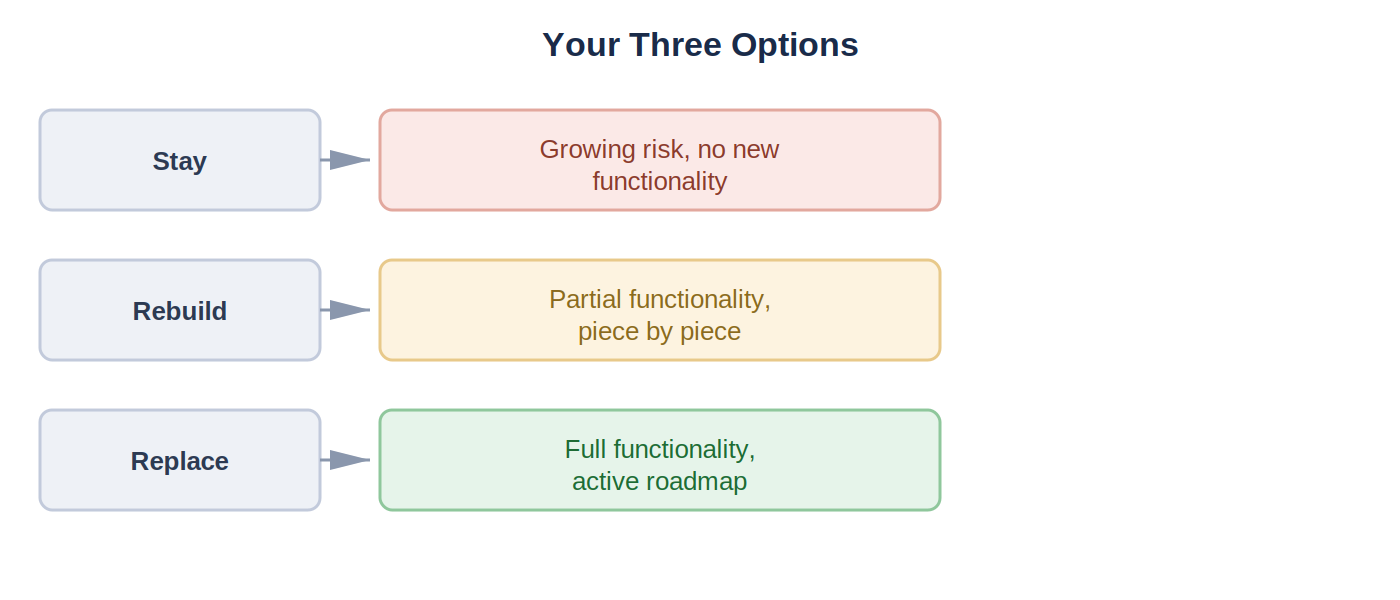
Stay
If SSM is still meeting your needs today and you're not under pressure to change, staying is a legitimate short-term choice. It's not a long-term one. Every year on an unsupported-in-spirit platform makes the eventual move harder, not easier, as institutional knowledge fades and the gap between SSM and modern reporting expectations grows.
Rebuild
Some organizations consider rebuilding similar functionality on general-purpose BI tools they already own. This can work, but it usually means reassembling scorecard, strategy map, and initiative-tracking functionality piece by piece — features SSM gave you out of the box.
Replace
The most direct path is moving to a platform purpose-built to do what SSM did, without the fixed asset problem. This is the option most SSM customers we talk to end up choosing, largely because it's the only one that doesn't ask them to trade functionality for peace of mind.
What a Successor Should Keep
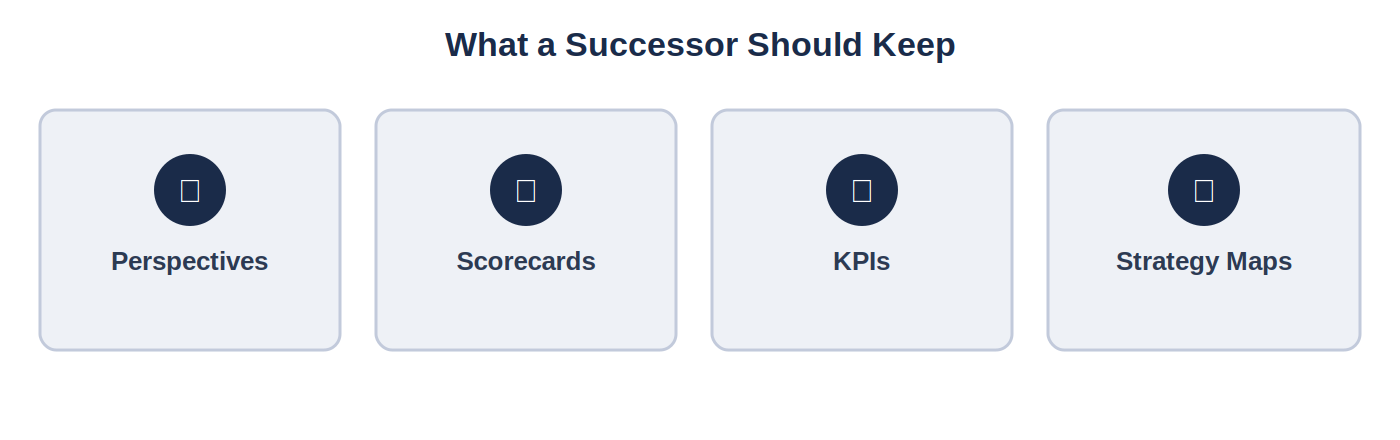
Whatever you replace SSM with, the functionality that made it useful in the first place shouldn't disappear. At minimum, a successor should keep:
- Perspectives that organize strategy the way your organization actually thinks about it
- Scorecards that compare actual performance to targets, not just raw numbers
- KPIs tied directly to strategic initiatives, cascaded down through the organization
- Strategy maps that visually connect objectives across levels and departments
This is exactly the gap the successor to SAP Strategy Management was built to close. Cipher SPEAR was designed by the team with the most SAP SSM implementation experience, specifically to carry forward what worked about SSM's approach to scorecards, strategy maps, and KPI cascading, without the platform being a dead end.
Proven on Real Government and Enterprise Deployments
This isn't a theoretical migration path. Cipher has implemented SAP Strategy Management and its SPEAR successor across a range of government and enterprise organizations, each using the platform to publish strategic plans, cascade goals across departments, and track performance against targets rather than leaving the plan as a static document. Royal Eswatini Sugar Corporation, the largest sugar producer in Eswatini, has also named SPEAR as part of its strategy management and reporting toolset. A public power utility has gone through this same SSM-to-SPEAR transition as well.
How to Plan a Move
A move off SSM doesn't have to mean starting from zero. Because SPEAR was built by the team that implemented SSM most, the underlying concepts (perspectives, scorecards, initiatives, strategy maps) carry over directly, which means the planning conversation is less about relearning strategy management and more about mapping what you already have onto a platform that's still being actively developed.
A reasonable starting point: inventory what's live in SSM today (scorecards, strategy maps, KPI definitions, integrations), decide what's still relevant to your current strategic plan, and get a straight answer on what a successor platform would need to replicate versus what's safe to leave behind.
Still running SAP Strategy Management?
See how Cipher SPEAR carries forward what worked about SSM, without the dead-end roadmap. Book a short demo.